Strangers are friends you haven’t yet met

Standard

When I was about seven we moved from Surrey to Oxfordshire and a friend of my mother’s presented her with a plate with the words ‘There are no strangers here only friends you haven’t yet met’ curling around the edge and a picture of two presumably stranger friends in the centre.

plate

To my seven year old brain this just didn’t make sense. For one thing I’d had it drummed into me from an early age that you don’t accept sweets from strangers* but if strangers were just friends in the making could you still not accept sweets from them or did that mean you couldn’t accept sweets from friend’s either?

But mostly the plate’s advice just seemed impractical. There are an awful lot of people in the world and most of them are strangers, if they were to become your friends how would you possibly remember everyone’s name and if they don’t become your friends then is that just a massively wasted opportunity? Granted new friend’s made since the tender age of seven have started off as strangers but surely that’s no reason to try and befriend everyone you’ve never met?

I learnt another saying at school that all medicines are drugs but not all drugs are medicines. Now steering clear of debates around benefits of homeopathic remedies this one actually made sense to me and could perhaps be adapted for the plate’s purpose? Something like ‘all friends start off as strangers but not all strangers are your friends’?

Or perhaps the plate just needs a couple of additional lines of text to complete the phrase ‘There are no stranger’s here only friends you haven’t yet met, except for the weirdo’s you should definitely avoid rummaging through the bins looking for razor blades and laughing hysterically at anything David Brent says’ (there go any potential Office fan friends I could have made).

However, last week I was forced to concede that the plate may have a point. The fiancé and I were invited to a wedding in the Algarve, the groom-to-be being a good friend of my fella’s. Aside from the man I’d packed in the suitcase and bought with me, I was going to be spending the week with eight to twelve strangers in our villa and an additional ten in another villa a few minutes down the road.

We arrived a few hours after everyone else to be met with a barrage of people whose names I thought I’d never remember. Afraid of potentially awkward small talk after a long journey and general bewilderment and, being a lover of all things watery, I decided to go for a dip in the pool.

As I bombed into the water and started swimming a few lengths in the cool waters on that first evening, marvelling at the sun setting behind the awesome pine trees fringing the golf course view, I was unsuccessfully trying to pretend the others didn’t exist whilst being overtly conscious of not knowing anyone.

Fast forward to the end of the week and my final swim. That last swim in the fading light, at the same time of day as the first, with the same light shining through the same trees, I couldn’t help but reflect on how different I now felt. I compared that initial awkward swim amongst strangers with the much more enjoyable relaxed swim in the familiar surroundings of the villa where I had shared so many happy memories with new friends.

OLYMPUS DIGITAL CAMERAAnd I had shared a wonderful week, including the most intimate wedding I have ever attended, with all those people I didn’t know who became my friends.

I believe that there are different friends for different times of your life (see ‘absence makes the heart grow fonder’) but that doesn’t take away the significance of these friendships. Some of those friendships made will last and some won’t but it doesn’t matter as all of them were important. This particular bunch of strangers actually were all friends in waiting I’d simply not met before.

I like to see the best in people and like to believe that hidden within everyone, admittedly deeper in some than in others, is a decent person. And that is pretty much the same as the plate would have me believe.

So maybe all strangers are potential friends we haven’t yet met or had the chance to get to know properly? Perhaps there is simply more truth in chinaware than we realised? But then again those razor blade hunting bin people do seem pretty weird. Maybe I should get that printed on a plate?


* Interestingly that rule completely goes out the window once you hit adulthood when you can accept all sorts of random things from complete strangers without any qualms. Even where those strangers are obviously trying to influence or entice you in some way: free pens at conference/cereal bars outside stations/ free gifts when you spend a certain amount ring any bells for anyone?

The Blog Hop

Standard

I have been nominated to participate in a blog hop by WA Woman to World, which entails answering the questions below and then nominating two other blogs to share their responses.

Firstly, thanks Michelle for the nomination. I met Michelle at my very first Geneva International Book Club meeting. The club is a lovely(ish) group of people whose warm welcome to Geneva, where every comment is welcomed and valued if not necessarily agreed with, made me first feel at home in this strange city. And Michelle was one of the first people here in Geneva I really connected with. I was delighted to discover her blog and get to know her better through this medium as well as regular book club meets and to discover what a warm-hearted, funny and inspiring woman she really is. I loved her blog so much that it motivated me to start my own and her words of support were really encouraging.

What are you working on?

That really depends on how you want to define ‘work’. If we are going for the traditional sense in terms of societally-defined gainful employment for which I exchange skills for the money to pay rent and eat, then I am working for an international NGO for the advancement of human rights.

Human rights has been something I’ve been passionate about since we had a talk from a representative of Amnesty International when I was in secondary school. I felt a pull to do something about the global inequality where the rights I take for granted are denied to so many others. This started with my joining a local Amnesty group, later I undertook a Masters Degree in Human Rights, an internship with the Cambodian Centre of Human Rights followed in 2013 and now I’m here in Geneva hoping to put my organizational skills to use for something I care about.

In terms of the broader sense of ‘work’ well, I now have this blog but, my biggest non-work-work is ‘me’. It’s an ongoing project to try and be the best version of myself, not to let myself be held back by fears and to open myself up to new experiences whilst at the same time learn to appreciate the here and now. It’s an ambitious challenge I suspect won’t be finished anytime soon. At the moment, to provide slightly more specific examples, it includes learning French, enjoying a healthier version of me through improved diet and increased exercise, practicing drawing and trying not to be so darn addicted to social media apps on my phone and at work.

How does your work differ from others of its genre?

In terms of the blog writing, I wouldn’t say I have a unique voice or perspective, because I doubt whether there is any such thing as a truly original thought or piece of work. Even if you think you are being radically different from everyone else there are probably loads of other people with exactly the same idea, which may or may not have been put into practice or vocalised yet. Or perhaps I’m just not original enough to accept the concept of originality in others.

I started my blog thinking what I was saying was revolutionary, that no-one would have heard anything of the like before. I was quite astounded by the amount of people who came back to me saying this is exactly how they feel. At first I felt a little put out by that but actually I’ve realised how great this is and now I love the idea that through opening myself up on the blog others may find things they can relate to. Through doing my part to create a little interconnectivity I hope we can all feel a little less alone and a little stronger.

But even if we share the same ideas with others which ideas we have in common, how we voice these, how these affect us and shape our own understandings is unique to all of us. I’m trying to hold onto the thought that I am both nothing more than a snowflake in a blizzard and nothing less than a one of a kind snowflake. It’s a dizzying vertigo effect of trying to balance one’s own sense of self-importance with the realisation of one’s insignificance.*

Perhaps my work is different in not trying to be different and not really trying to be anything more nor anything less than mine? Or perhaps it’s the same as everyone else’s in this respect?

Why do you create what you do?

For some time I’ve thought there is a novel or two inside me but it occurred to me that I wouldn’t become a bestseller anytime soon unless maybe I started writing a bit more frequently. I then met a couple of inspirational bloggers and I thought I’d start my blog as a technical challenge to polish my writing skills. However I completely underestimated the effect that blogging would have on me and this developed into a passion in itself.

I wasn’t sure, and still aren’t, exactly where I wanted to go with the blog and what I wanted to say. But I did know that I wanted to write honestly about who I am and how I understand and interpret the world around me. Through trying to truthfully address my sense of self and then put it out there for others through this blog it’s actually helping me to understand myself better.

The concept of the blog was to spell out my life philosophy and how I’m applying that on a daily basis. Since starting the blog I discovered my philosophy isn’t as concrete as I had imagined and is constantly evolving, so this will continue to be something to work on.

How does your creative process work?

Deadlines are pretty essential to how I operate. I’m very good at wasting time and can spend whole weekends doing nothing more than flitting between television, books or perhaps having a little wander outside. I blame my dad, he is king of the procrastinators and passed that particular talent on to me.

So I imposed a weekly deadline on myself, which I’ve actually managed to stick to reasonably well, and try to avoid the trap of thinking ‘oh well it doesn’t matter this week’. I know that sort of thinking will be a slippery slope for me because if I start to make excuses it gets easier to keep on making excuses and before you know it months will have gone by without a single new post.

Knowing I have the weekly deadline means my inspiration drive is pretty much always whirring away in the background looking for ideas for the next post. Sometimes it’s obvious and I’ll see, experience or feel something that moves me to write and sometimes I have to work a bit harder to try and find anything worth expressing. I’m starting to develop a little store of rainy day blogging ideas to avoid moments of panic about what the heck I’m going to write about next, which has happened a few times.

Book club has also been a useful muse by pointing me towards reading books I wouldn’t have read otherwise, thinking about books in greater depth than I used to and most importantly from getting insights into others on how they have interpreted the same texts I’ve read. We all have the same material but our brains make quite different work of it, proving humans are pretty amazing and providing plenty of food for thought.

My nominees

I have chosen to nominate the blog ‘Lori and the Caravan.’ Lori is a truly inspirational person who is not afraid of a challenge and shares her experiences openly and honestly through her blog. Amongst other things she is a loving mother, a historical geek, a passionate vintage promoter, and, obviously a blogger. I worked with Lori in London and then our lives took us in different directions and we drifted, but I’ve been able to reconnect with her through her blog. You can also check out her shop and start thinking of little people you can buy Lori’s great vintage finds for.

My other nominee is the brilliantly insightful ‘Self-styled life’. This was one of the first blogs I discovered when I started my own blogging adventure and it really resonated with me. Despite the fact Jean and I have never met, live on different continents and have very different lives I have felt a connection with her through her writing. When first starting out it was really encouraging to find a blogger that could entertain and move me (my last blog post was directly inspired by one of hers). Her blog was the first stranger’s blog I dared to comment on and I have really appreciated her warm and thoughtful responses to my random comments. It’s nice to know the internet isn’t such a scary place full of trolls under every article.


*This is starting to sound either a bit profound or super self-indulgent and poncey, sorry if it’s the latter.

The age-old question

Standard

I recently read an interesting post ‘In Defence of Aging’, which has got me thinking about that age-old question, which is really two questions: 1) Am I getting old? And 2) Do I care?

What is old?

Age is a funny thing and the perception of old-age is a fairly fluid construct, in that the closer you get to it the further it moves away.

When I was five and the 1990 World Cup was taking place I remember my dad telling me that the next World Cup would be in four years time. To my five-year old brain four years might as well be the end of the world. And from a five-year old’s perspective, when one year is a fifth of your life, then four years is a lifetime.

If we compare that to now, when the 2014 World Cup finished with yet another disappointment for England (and to be fair every other team that wasn’t Germany), my perception is slightly different. It’s only another four years to the next World Cup, barely a wait at all and only a fraction of the life I’ve already lived.

At the age of 10, 50 sounds ancient. At 20 the gap between youth and old age both narrows and widens. 30 sounds terrifyingly old but at the same time 60, which used to turn people into Old Age Pensioners, doesn’t seem nearly so old now that we’ve seen parents and friends surpass that particularly year without curling up into a useless mass of pointless existence.

My grandma is 93 but she has only just accepted that she might be old and only a few months ago she threatened to kick anyone that dared to suggest she seemed to be doing very well for her age. ‘What do they mean,’ she’d indignantly ask ‘at my age?’ 93 does seem pretty old but perhaps when, if, I’m in my 80s I’ll probably be thinking ‘90 isn’t old but 100+, now that is old’.

Am I getting old?

So next year I’ll be 30 and with this upcoming change of decade I’m not entirely sure whether I ought to be feeling:

  • denial (‘no, I’m not 30, I’m 29 (again)’)
  • anxiety (‘I’m going to be so old I wont be able to enjoy childish things like going to the zoo anymore unless I actually have children or borrow someone else’s’)
  • disappointment (‘I thought I’d have done more with my life by now’*)
  • relief (‘thank god, I’m no longer in my twenties, I pity those young’uns searching for jobs, trying to save up for a house’)
  • anything in particular at all (‘maybe I wont transform into a different person with a whole new perspective in life’).

I think feeling old is something we put upon ourselves. Last year, when I was in Cambodia doing an internship I was conscious of the fact that the other interns were all younger than me but it really didn’t matter. My being a few years older didn’t mean we had nothing in common and couldn’t relate. In fact, one of the people I was closest too was one of the youngest of the group but we connected as people not as age-brackets and no segregation of years (or geography for that matter) affects our continuing friendship.

Currently, I don’t feel old but I don’t feel particularly young either and actually that’s okay. I’m a lot more confident now than I was in my early 20s and care a lot less about what other’s think so I don’t really want to go back to that more anxious, albeit slightly younger, version of me.

Do I care?

Laughter linesHere is a picture of me taken up a tree during the rope course adventure I tried recently and at first glance, I thought that’s a nice picture (judgement criteria being: I don’t look fat or overly shiny). On closer inspection I note the laughter lines around my hair and a few grey hairs wisping around my head. Does this proof of aging make it less of a nice picture? Again, it depends on your perspective.

What I liked in the defence of aging post, referred to above, was the idea that the lines on our faces don’t so much add character as show our character. I love that the lines around our eyes are called laughter lines because that’s such a friendly non-threatening concept. Yes, I have quite a lot of laughter lines but I’ve spent a lot of my life laughing and as they show up most when I’m grinning away is it such a big deal for other people to see them? Not really. Yes, I have grey hairs now and every so often I will dye these, but does existence of these prove I’m past my sell-by-date?

We recently had vast amounts of ‘expired’ chocolate donated to our office. It still tastes great, and even the resident Belgian (by birth a chocolate connoisseur) agrees. So I might be old in the eyes of some but that doesn’t mean I’m actually past-it.

I was filling in a form at work recently with a colleague who misheard when I gave my date of birth and wrote 1995 rather than 1985. I laughed and expressed thanks for making me 10 years younger and then I instantly took that back because I realized I don’t actually want to be 19 any more. On the whole I’m reasonably happy with how I lived the last 10 years and the 19 before that, for that matter. I don’t want to be 19 again and I don’t really want to look 19 again.

There’s a poem I like, written by someone who set himself the challenge of writing a poem a day, on the topic ‘If I could do it all over.’ The subject of the poem reflects on the ups and downs of his life and decides that if he had the chance to live his life again he wouldn’t change a thing because then he wouldn’t be the person he is today. If I were offered the chance to relive my life and return to my ‘youth’ I think I’d rather stick where I am as I am grey hairs and all!

I’m not saying I’ll happily accept the continued greying of my hair and wrinkling of my skin but I am going to try not to worry about it. It’s part of who I am, evidence of who I’ve been and evolution of the person I will become. And aging is definitely better than the alternative.

Getting older is inevitable but if getting old is a state of mind and my mind is willing to show flexibility in this area then I don’t seen any reason to have to feel old any time soon or, actually, ever.


* Granted the fear I haven’t done enough with my life is going to affect me, but that’s because this is something I’m already worried about, have been worried about since leaving University and will probably continue to worry about in the future. That’s pretty much what this whole blog is about.


The fears we all share

Standard

“the only thing we have to fear is fear itself,” Franklin D. Roosevelt 1933

“what you fear most of all is – fear. Very wise,” – Professor Lupin, Harry Potter and the Prisoner of Azkaban by J.K.Rowling

This post is for anyone who has ever tried to face their fears, even if they haven’t always been able to overcome these, and for one particular friend whose constant attempts to combat her aviophobia has been truly inspirational.

We all fear different things, some of us fear snakes (ophidiophobia), some of us fear confined spaces (claustrophobia), and apparently some of us even fear beards (pogonophobia). My biggest fear is wasting my life (deficit-vivophobia?).

Much like Roosevelt and Professor Lupin said what my fear really comes down to is itself. I am afraid fear will stop me from living my life (see The Why), so to stop this paralysing me, when I know I’m scared of things I try to confront them.

For example, I used to be afraid of groups of young people (all that slang and acne is terrifying) so I volunteered for a youth project working with these very same frightening specimens and I actually quite enjoyed it.

I know that fears come in different shapes and sizes and for some they are much more debilitating than for others and I wouldn’t want to belittle that. For those people with genuine deep-seated phobias then facing those fears head on may not necessarily be the best course of action for you. Especially if your fear is of being run over by busy traffic.

Most phobias are things we acquire in life, whether consciously or subconsciously, and the only fears we are born with, that are innate to all human beings is that of loud noises (ligyrophobia) and that of falling (basophobia). Being a brave soul (pronounced ‘moron’ in some dialects) I have tackled both of these fears since my arrival in Geneva.

I took on the fear of falling by willingly agreeing to participate in a rope adventure course in the trees of Annecy (a lovely French town near Geneva) with a group of friends from work. I’m not ashamed to admit I was a little anxious. We all share this same fear of falling and chances of that fear being realised are somewhat increased if we choose to clamber about trees on unstable pieces of wood tied together with bits of string. But I thought about it sensibly and concluded that it would be bad publicity, and therefore not in the park’s interests, for its clientele to fall to their deaths, so I decided to trust in the harness, grips and cables to prevent my plummeting to the earth.

I can honestly say as I performed each task, varying in intensity and requiring an immense amount of concentration wobbling form one bit of wood to another, I utterly failed to enjoy each moment, but what made up for all this anxious manoeuvring was the adrenaline rush that kicked in after I landed on each secure platform in the trees.

Zipline!However it surprised me to discover that the zipline concluding each course was the biggest challenge I was to face throughout the day as I had anticipated this to be the most fun. What I hadn’t thought about was that you have to deliberately let yourself fall from a platform some 30 feet up.

Every fibre of my being was screaming DO NOT DO THIS, THIS IS A BAD IDEA but I thought if we can learn to be afraid of things we can also learn not to be afraid of things. I had my harness and as there wasn’t a pile of bruised and battered bodies on the ground below I decided I could trust in this and overcome the fear.

And actually the zip line was amazing, I really did enjoy the sensation of whizzing through the air suspended from a rope. The fear of falling wasn’t something I permanently overcame but I managed to overcome it enough when I needed to and to be able to enjoy that moment. I think that counts as a success.

The fear of loud noises I challenged by having a go at shooting real guns with live ammunition. I have tried shooting before, when I was in Cambodia, but that was quite a different experience where safety is barely a consideration as you are presented with a restaurant-style menu of guns to choose from at different costs and apparently if you really want to, and have $300 to spare, you can pay to blow up a live cow. I don’t want to kill things but I like shooting, I don’t believe the two have to go together.

In Geneva my shooting experience has been in a safe indoor environment with a trained firearms instructor drilling the importance of safety into me and without even the hint of an option of blowing up farmyard animals.

I like the psychology that’s involved with shooting. Most people when shooting for the first time recall their fear of loud noises that will come from the gun exploding. The result of this is an instinctive reaction to push the gun away from you and to close your eyes at the moment of pulling the trigger. This has the effect of forcing the gun down and results in shots falling below their intended target.

For the record not how you should hold the gun and definitely shouldn't have been allowed to take a photo whilst pointing a real gun at someone!

THE CAMBODIAN SHOOTING EXPERIENCE. For the record not how you should hold the gun and definitely shouldn’t have been allowed to take a photo whilst pointing a real gun at someone!

Part of the instruction is trying to overcome this fear and as the fear of loud noises is innate the best way to go about this is in trying to trick yourself so that your body doesn’t react until it is too late and the shot has already been fired. It is a wholly absorbing pastime as every shot requires an intense amount of concentration as you think about maintaining the correct position, lining up the sights and pulling the trigger very slowly (so the moment of explosion takes you by surprise).

Yes, every time the gun goes off and makes that loud noise it is startling but you learn to overcome this alarm so that you can make each shot and have the satisfaction from seeing yourself improve.

Fear is an involuntary reaction but it is, for the most part, if not exactly curable, at least controllable. We can challenge ourselves to face our fears and sometimes it can actually work out pretty well. If we cannot become fearless we can at least be courageous for as a great man once said:

‘I learned that courage was not the absence of fear, but the triumph over it. The brave man is not he who does not feel afraid but he who conquers that fear.’ – Nelson Mandela

Unless that fear is spiders (arachnophobia), when I recommend leaving well alone until a bearded man removes it or a cat eats it. Unless you are also afraid of bearded men and cats, in which case maybe just running away as fast as possible is the solution.

The Still Life

Standard

Following on from my little self-discovery last week that I’m not overly great at living in the moment I thought I’d try and open myself up to some tasks that might force me to do just this.

So yesterday I participated in a life-drawing class where attendees take it in turns to pose for one another for 10-15 minutes stints whilst the others sketch them so that the group are provided with models to practice a bit of artwork. (In case you were wondering, no, this wasn’t nude life sketching.)

I used to love doing arty things when I was younger but one year of art A/S level at the age of 17 was enough to put me off it for almost a decade. I had thought that art would be a relaxing, or at least different way of engaging my brain, alternative when picking a-levels. A balance to the History, English Literature and Psychology I was also studying. But it was actually the most stressful of all these subjects as the workload was immense and I felt constrained by my teachers perspectives of what did and did not constitute art, in their narrowing definitions of uninspiring assignments.

Recently, however, I have been picking up the odd pencil, paintbrush and pritt-stick (after all, what’s art without a little cutting and sticking here and there) in attempts to make thoughtful presents for friends. For those unfortunate few with a Pottsy original art piece I can only apologise and hope that what I lack in skill I made up for in effort. And should that piece of art accidentally get lost in a house-move, randomly set-alight by art-hating anarchists who broke in or just be destroyed by the dog, I will understand.

However, having re-found my love of artistic endeavours, if not achievements, I thought perhaps I could attempt to actually improve my abilities. I don’t deny that a lot of artistic aptitude must come naturally to talented artists but it occurs to me that regular practice might help here as it does with so many other things in life, such as learning a language.

The life-drawing class afforded me that opportunity to practice. I wouldn’t have to spend hours pondering what I might draw, only to change my mind seventeen times as each sketch deviated further and further away from the vision I had. I would have to make a number of quick sketches of people. I wouldn’t have the problem of not knowing when to stop or how to start. Much like an exam, I’d simply have to get on with it once the clock started.

The fact we’d be sketching people, something I’d always tried to steer clear of even when I used to love art, added another element to the challenge and I was looking forward to* trying something new and opening myself up to the perceptions of others, both in how they drew me and what they thought of my attempts to draw them.

However, whilst I did want the chance to practice my sketching, what really motivated me to sign up for the event was the trial of having to sit still for 15 minutes with no distractions, when it became my turn to pose for the other students. No talking, no checking the latest facebook updates or emails, no reading a book, no televison, nothing, nada, rien. Just me, myself and I.

A drop in the oceanGranted 15 minutes isn’t actually a very long time but when sat in one position with nothing but my thoughts it seemed infinitely longer. I tried to think of meditational-ly things, thinking of myself as a star, unique but one of a multitude in the universe, or as a drop in the ocean. All the while focusing on a tiny patch of the floor, black and white speckles on the grey linoleum. When the specks started to blur and my eyes started swimming I thought I’d better change my tactic so I resorted to my usual strategy for passing the time in situations which make me slightly uncomfortable, like waiting for the tube on a crowded underground or having a massage. I started counting in French, slowly, to one hundred and then back again.

Before I knew it my time was up and I could move again, but actually although my thoughts, or rather my counting, may not have been the most profound they did root me to the moment and I was quite content, in a semi-trance like state, of just being. It was quite a calming experience.

The actual sketching highlighted the fact I need to practice more, but aside from this was, in a way, as meditative as the posing. Whilst there wasn’t time for profound thoughts about stars and oceans or even the Swiss French for the number 79, because time was so limited and concentration was so demanding, there wasn’t space for any other thoughts either. So the usual internal dialogue about what I’m doing with my life, what’s for dinner, does everyone at work secretly hate me was completely silenced.

Whizzing away on my bicycle at the end of the evening I felt a sense of tranquility that’s been absence of late. I can’t wait to go again.


* By looking forward to I mean in the abstract sense where I liked the idea when I signed up and it was too far on the horizon to actually be happening and then with every minute the actual event got closer the dread gripped tighter and tighter and I desperately willed a last-minute cancellation. I couldn’t just not show up that would be poor Glocals etiquette. (Glocals is a Geneva expat forum which, amongst other things, provides a space for organizing activities, where this particular event was listed. For friendless people new to the city it’s a treasure trove of ways to fill your time.)

The exhausting adventures of an over-organiser

Standard
The last week or so has been something of a whirlwind as the fiancé and I came back for a wedding and decided we would stop in the UK for the following week and visit as many people as humanly possible.
In 11 days we clocked up around 1500 miles between us, which is about 4 times the length of England, as we traversed the South East, Midlands and North. We managed to visit both sets of parents, my grandma, Tom’s grandparents, my aunt and nine separate meetings with friends.
This logistical feat of pulling off the who, how, where and when of maximising UK friend and family absorbing time has caused me to finally accept that I am good at this sort of thing. So in acknowledgement of my true self I’d like to say ‘my name is Briony and I’m an organiser!’
Despite the fact I have been in a number of jobs where organisational skills are an absolute must I never really think of myself as being an organised person, because I have always felt I could be better at this. But this doesn’t really make sense. It’s like me saying I’m not a runner because even though I regularly run 5k a couple of times a week (brag brag) I could be better at this. So yes, I could be a better runner and I could be better organised but this doesn’t stop me from already being both of these things.
An essential requirement of being disorganisedly-challenged (desperately trying not to keep repeating ‘organised’) is the ability to plan ahead. The amount of people we managed to fit in on a relatively brief visit was a result of my spreading out the charts and forming a touring battle-plan, if you will, carefully scheduled to within an inch of the agenda’s life.
Had I left the UK trip to the fiancé we’d have gone to the wedding and then just pootled about in London for the rest of the week and seen a couple of people. Granted, this might have been a relaxing alternative but, having been an expat abroad for almost 6 months now, would have seemed a wasted opportunity.
My methodical and systematic approach to work, holidays and so on definitely has its place but I know that I’m capable of this sort of thing because it comes naturally to me, which means I can’t really turn it off. And always going about my life in an orderly and controlled manner isn’t necessarily a good thing. For one thing, it sounds pretty dull. Nobody wants to be described as ‘organised’, even if it does get you jobs and has practical purposes. For another, I’m also pretty rubbish at spontaneity and just doing things on the spur of the moment.
However, the most debilitating aspect of being Queen of the Planning is that I find it almost impossible to live in the moment and actually just take stock of where I’m at without constantly question where I’m going.
On a day to day scale I can do this to some extent, I can enjoy a nice leisurely walk and stop to take in the view and think how great it is to be in the here and now. But I can probably only manage this for an hour or two at best before the brain starts going into overdrive with thoughts of ‘what’s next?’
I’ll eat lunch and even as I’m eating it I’m already thinking about what’s for dinner. If I’m having an evening out with friends I’m perfectly capable of enjoying myself, and it’s not that I’m wishing the night were over its just that I’ll probably also be thinking about what time I’ll be home and what I have to do the next day.
On a small scale the over-planning’s not so bad, on a bigger scale it’s exhausting. Moving to Geneva happened fairly quickly and there was a lot to sort both before I went and then after I arrived. This preoccupation worked pretty well at distracting me but now I’m more settled here I can’t stop contemplating the future.
Should I start studying again? Where do I see myself going within the new job? Will we come back to the UK in a couple of years and if not, do we stay here or go somewhere else? Should I have a career figured out by now or at least have all required training out the way before thinking about children? And on and on it goes. I don’t know how to just sit back and think well Geneva is nice and leave it at that.
When I was working full time in the UK and also studying part-time and trying to see friends and family and sometimes taking on voluntary work it was pretty manic. I often look back and think how the hell did I manage that? So now I’m kind of enjoying a more relaxed pace of life, and think my hair is greying at a slower rate, but I’m also kind of hankering after those activities that serve so well as distractions. Always working towards things in the future means you don’t really need to think about what your place in the world is now and what the point of it all is.
I clearly need a new project.
We had a great time back in the UK and loved every minute catching up with those we got to see, although still missed a fair few off the list, but the whole thing was a little hectic. To ensure we get round everyone at a slighlty more leisurely pace I’ll have to plan a number of trips over the course of next year. I hope it will be enough of a diversion for now.

The art of public speaking

Standard

This weekend was the wedding of one of my very best friends and, with her other Maid of Honour, I was tasked with delivering a speech to celebrate the occasion.

People laughed. I was told the speech was extraordinary, that people had never heard anything like it, that it was quite exceptional. The bride didn’t hit either of us. I’m pretty sure that counts as a success.

The bride was an old school friend who lived less than a hundred metres away from me as a child so we were foisted upon each other from an early age as a convenient drop off zone for working parents. She knew my folks pretty well so they had been invited to the wedding. One of the guests on their table said that the Maids-of-Honour should be a comedy double-act and I’m sure they were in no way simply being polite to my parents. There was definitely talk with the bride’s mum about sell-out shows at next year’s Edinburgh fringe festival and I’m sure that was also meant seriously. We were evidently a knock-out.

Perhaps this doesn’t  need to be pointed out,  but public speaking isn’t a skill that comes naturally to me. However, I wanted to do a good job and make the bride proud. (I might have failed there.)  I asked mum for advice, who told me to make it funny so I thought I’d start with a joke or two to keep it light. The bride’s only request was to include the groom in the tribute so I bore that in mind when starting work on the speech.

I didn’t have much time to coordinate with the other chief bridesmaid but at the hen-do (bachelorette party for you non-Brits) we came up with a vague plan that we’d chop and change so that one of us would talk then the other and so on. As it happened we thought that approach might ruin the flow of our sentimental texts so we decided to just go one after the other. I was to go last.

I had planned and written out a speech, which I think balanced the humour and sentimentality reasonably well. Unfortunately that wasn’t the speech I delivered. I thought my speech might be a bit on the long side so tried to cut it down a bit the night before the wedding, and then again after the ceremony. But it wasn’t until the father of the groom gave his speech that I realised just how long my speech was. So when the other Maid of Honour decided to put down her speech and ad-lib I thought I’d do the same.

Her speech was a little brief,  mine wasn’t brief enough!

I didn’t want to go straight into the mushy stuff so started by telling everyone how much I used to hate the bride. Remembering to include the groom I also spent some time explaining how much I also didn’t like him very much when I first met him. I did at least manage to briefly touch on the fact I liked them both now but completely forgot all the sentimental wishes for the future and faith in their love stuff, which would have probably rounded it all off a bit better and made me seem less like I loathed everyone there! 

In retrospect it may have been better not to drink quite so much before the speeches began.  I was pretty nervous and thought  a little Dutch courage in the form of vast quantities of wine was the way forward. On the plus side I could use drunkeness as something of an excuse later. 

So if you were wondering how not to give a speech at a wedding then follow my example and focus on how you don’t like the bride or groom and see how well that goes down! Ideally with a suitable co-wedding party personage dancing behind you the whole time. If the father of the groom feels the need to give an impromptu speech to try and save the day you’ll know you’ve struck exactly the wrong note. 

I’m not entirely sure it was what the bride had in mind. I’m fairly sure in hindsight she wouldn’t have asked us to give a speech. Still, she did say that fear of us ever giving another speech again was a darn good incentive not to get divorced. So in our own, unique way, I think we can proudly say we have contributed to a lasting marriage! 

You’re very welcome Mr and Mrs C!

The ambition to be human

Standard

“It comes to this,” Tarrou said almost casually; “what interests me is learning how to become a saint.”

“Perhaps,” the doctor answered. “But, you know, I feel more fellowship with the defeated than with saints. Heroism and sanctity don’t really appeal to me, I imagine. What interests me is being a man.”

“Yes, we’re both after the same thing, but I’m less ambitious.”

– The Plague by Albert Camus

As promised to one brother I am returning this week to a less heavy-going, non-political, more happy-go-lightly post. This will probably disappoint my other brother but hey ho, you can’t keep all of the people happy all of the time.

This week in book club we were discussing Slaughterhouse Five by Kurt Vonnegut, which led to a discussion about post traumatic stress disorder and then about why some people care more about certain things than others.

There was general acceptance amongst the group, perhaps more readily by some than others, that to shut oneself off from the traumas of the world is an essential human coping mechanism.

I agree it simply isn’t possible to constantly feel for all the tragedies that are enacted out across the globe at any given time. Right now, current tragedies include the two Malaysian passenger air line disasters: one missing one shot down; the Air Algerian plane crash; the situation in Syria; the fact that there are now estimated to be more refugees than at any other time in history; the situation in Gaza; the rise of Boko Haram and the missing schoolgirls abducted in Nigeria; travesties of democracy in Cambodia; and Isis’s latest announcement that FGM will be mandatory. And this is just the tip of the iceberg.

There are simply too many awful things for us to focus on at any one time, even if we wanted to, and so we don’t.(Perhaps this post isn’t quite so happy-go-lucky as I had intended after all – sorry bro.)

One book clubber asked does it take a crisis to make us care? Certainly when a crisis takes place many people are great at demonstrating that they do care. When I was a student I worked at a call centre, which often volunteered to man donation phone lines in response to global disasters or for Comic Relief. I took donations from a wide range of individuals, from all walks of life, many of whom giving sums they couldn’t really afford precisely because they did care about what was happening and wanted to help. So people really are wonderful.

And some people dedicate their lives to making the world a better place for others, providing their time, money or skills for the benefit of others. These people are exceptional. These people are saints.

But it doesn’t make the rest of us bad people because we don’t dwell on these things all the time. Yes, there are many terrible things that happen but there are also many wonderful things that happen too and it is important, at times, to hold onto the horror and the beauty. But being able to enjoy life at the same moment in time that someone elsewhere isn’t enjoying life doesn’t make us the antithesis of saints. It makes us human.

If you are a dedicated fan of my blog (a.k.a. my mother) you will be aware that I called the blog fearofthereaper and started all this as part of an ongoing evaluation of how my life is progressing. More often than not my focus tends to be on positive things I have achieved to become the person I want to be, but it is also important to reflect, from time-to-time, on the things I’m less proud of and on the kind of person I do not want to be.

I do not have the ambition to be a saint, I do have the ambition to be a human. Like so many things in my life, this is something I have the power to realise.

Let me give you a recent example: I had just moved to a new area in Geneva, my French was worse than it is now (which still borders on Yoda-like gibberish) and I was walking to the nearest shopping centre when I walked past an elderly woman who called out to me in French.

Thoughts that ran through my head went something like this: oh no, a human being wants to interact with me and I’m not in the mood, she probably wants something of me that I don’t want to give, she might be selling magazine subscriptions, my language skills are so bad I probably won’t understand anyway, someone else is bound to help, not my responsibility.

And I carried on walking. After about 10 metres I turned to look back, saw no-one else had stopped but walked on a bit further. But then it hit me that I didn’t want to be the kind of person that would just ignore someone calling out to them and so I stopped pretending not to hear and turned around and walked back.

I understood enough French to feel guilty when she thanked me for coming to help her (guilty for not stopping straight away) and to understand what she wanted, which turned out to be directions to a place I didn’t know. So it turned out I couldn’t help her but I did wait until we could find someone who could at least speak to her intelligibly in her language and I did, eventually, try.

I believe all humans are capable of both wonderful and terrible things and the capacity for good and let’s not say evil but instead let’s say less-good is something that resides within all of us all of the time.

How much we are influenced by the good over the less-good depends on a lot of factors: what’s going on in our lives, how we are feeling, how others are treating us and so on. Often we can’t control these factors but we can control how we respond. This I think is what it means to be human, if we take being human as deciding to be the best version of ourselves that we can be.


Is the world mad or is it just me?

Standard
I’m sure we have all had moments of shocked incredulity at a situation seemingly accepted by others but which seems totally incomprehensible to ourselves. But the acceptance of others might ask us to question whether this really is a mad situation or whether it is in fact us. When confronted with this madness what do we do: do we protest in the bewildered face of others or simply keep our heads down and wonder in silence?
This is a bit different to my usual postings (if after two months of blogging you’ve identified a trend) and it’s not really about me but is inspired by three men unable to accept the madness of the world around them and in protesting this perceived insanity earned the ridicule of others.
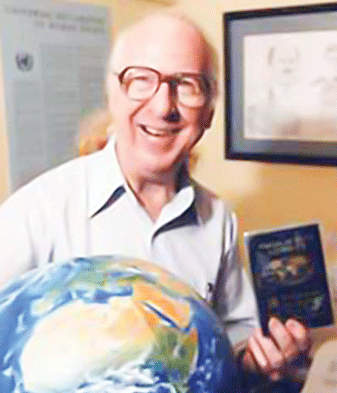
This week, whilst undertaking a spot of filing, I came across a number of letters from a Mr Garry Davis. He was a very public and active promoter of his cause, that died around this time last year, so I think it’s okay to reference him by name.

Mr Garry Davis

At first glimpse I thought these are just the ramblings of your average fruitloop. There was an excessive use of capitalization and exclamation marks, which I tend to interpret as a mark of crazy. (Let me just re-type that last sentence and you’ll see what I mean. There was an EXCESSIVE use of CAPITALIZATION and exclamation marks, which I tend to INTERPRET as a mark of CRAZY!!!!!)
But then I started to read his correspondence more carefully and did a bit of research (for ‘research’ read ‘I Googled him’) and what I discovered wasn’t as mad as I had first thought. In a nutshell Mr Davis was an American World War 2 veteran who, disgusted by the senseless killing he himself participated in, decided to renounce his US citizenship and declare himself a citizen of the world. He believed that lasting peace could only be obtained if nationhood and the accompanying violence of territorial wars ceased to exist.
Mr Davis was committed to his cause for which he was arrested, deported and probably subjected to more assumptions of crazy than just mine up until his death at the age of 91. He promoted world citizenship and produced world passports in the belief that there should be no borders and people should be free to come and go as they pleased. For many stateless refugees he was an inspiration and to this day the One World Vision has many hundreds of thousands of followers. He was a man committed to his visions in a world that didn’t want to listen to him.
Will there ever come a time a century or two from now when all the world citizens, devoid of nationality, look back at this part of history and question why everyone else was so happy to accept what is patently a very bizarre set-up in the form of statehood?

Mr Brian Haw

Next on my list of uncompromising protestors is Mr Brian Haw. I used to work at Parliament and as someone frequently subjected to the torrent of words spilling forth from Mr Haw’s megaphone it was easy to dismiss him as a nutter and nothing more than a nuisance.
In 2001 he set up camp on Parliament Square in London protesting against US and UK foreign policy in relation to the situation in Iraq. Parliament tried to get rid of him by enacting new legislation to prevent permanent protests in that area, but as Mr Haw’s protest was ongoing and established prior to legislation he became the only person legitimately entitled to camp outside Parliament. And camp there he did, through all weather extremes, until his death in 2011.
Mr Haw claimed he was protesting for a better future for his children. That’s probably not the only reason behind his actions and how happy his children, who he left behind to undertake the protest, were with this argument is another matter. But if Mr Haw genuinely believed his protest was the only means he had at his disposal to ensure a better future for his children, that it wasn’t possible for him to be quiet and accept the reality of war, was he really as mad as so many dismissed him to be?

Mr Siegfried Sassoon

Finally I come to my last of those champions of lost causes and my personal favourite: Mr Siegfried Sassoon. Siegfried Sassoon real life fox-hunter, poet and Great War Veteran reached a point when he could no longer not protest at the futility of war and the waste of life he saw all around him. Knowing full well the futility of his actions he threw away his medals and wrote a letter to a national newspaper protesting against the war. His actions earned him a spell in a mental hospital for shell-shocked officers.
(Regeneration by Pat Barker is a great book that blends history and fiction in exploring the madness of war and will tell this part of Sassoon’s story better than I can.)
In the mental hospital Sassoon encountered Wilfred Owen and encouraged him to express more forcefully the horrors of war in his poetry. So he may have failed to stop the madness of war but at least through his own poetry and through the encouragement of better-known Great War poet Owen, he managed to communicate the madness to others despite the heavy censorship both poets were subjected to. (Interesting piece on BBC news about censorship of Sassoon here)
Whilst the wastefulness of young lives during the Great War is now widely accepted, at the time Sassoon’s protest was not. Far easier to dismiss him as mad than accept the truth of what he had to say. Time has vindicated Mr Sassoon and perhaps it will also vindicate Mr Davis and Mr Haw in the future? Undoubtedly there will be many things we accept now that future generations will consider utter madness.

The arrival of the fiancé!

Standard
Being deeply loved by someone gives you strength, while loving someone deeply gives you courage.’ – Lao Tzu.
On Wednesday my fiancé came to Geneva. Not for a visit but to live. This isn’t a post about how my life is all sunshine and roses now that he’s here. Neither is it a post about mourning for the end of my Swiss bachelerotte days. If anything this post is a bit of a shoulder shrug to whatever it is I’m supposed to feel about all this.
I’m afraid I am not of the ‘You’re Nobody til Somebody Loves You’ philosophy (sorry Dean Martin). Nor do I believe that my fiancé completes me or that my life was somehow lacking until I met him. Don’t get me wrong having him to share my life with is great and he complements me in a way that has enriched my life, it just hasn’t made it ‘whole’.
What I love most about him (see I’m not so unsentimental I can’t use that word) is that he endorses the idea that it’s alright being me, because I’m alright as I am actually. I’m not a puzzle missing half the pieces that he gets to transform into the full picture.
And with the fiancé and the cats and the unpacked belongings in the new flat Geneva is starting to feel a bit more normal. But that feeling of normality is strange in itself. I’ve been here for over four months now but up until now it hasn’t really felt like I’ve lived here. I’ve worked, I’ve explored, I’ve tried new things and met new people but it has all felt a bit transitory. Now that he’s arrived the Geneva adventure has taken on more of a realistic tinge and has become that bit more ordinary.
People keep telling me it must be wonderful and so much better now he’s here. And it is but, if I’m honest, it is also going to take a bit of getting used to. I’ve had a fair few visitors since I’ve been here so I’m used to giving people my undivided attention and a glimpse of Geneva living. I’m also used to them going home after a few days. What I’m not used to is the constant presence of someone else sharing my life with me. Or more precisely this is what I’m no longer used to.
Screen Shot 2014-07-04 at 2.22.17 PMMe and the fella have been together for quite some time (seven years and counting). We’ve worked together, got cats together, lived together, been on holidays together, grown together and even managed to get engaged. It’s not like I’m not used to him its just that for the last four months we’ve been living completely separate existences that we’ve talked to each other about but haven’t shared in the same way.
He’s had to deal with all the realities of our upping sticks and moving to Geneva as I left in a bit of a flash and wasn’t able to help much in the wrapping up of our UK life. He had to move back in his with parents, sort the flat out for renters, notify relevant people/companies/etc. about leaving the country and finish up at work. I’ve had to carve out a new life for myself here, find a flat, find my way around, work out how the public transport works!
This rather special human being has enough faith in me to uproot his life entirely to take a chance on Geneva living with me. That’s a truly wonderful thing, it’s also pretty terrifying. It’s one thing taking chances and trying new challenges that just affect me, it’s quite another taking chances and trying new challenges with the responsibility that if it all goes pear-shaped it wont just be me that suffers the consequences.
Over the course of the seven plus years we’ve been together. We haven’t completed one another but have come to know each other well enough that we can both derive strength from the relationship and have courage to face challenges knowing that we’ve got a bit of reliable back-up in our corner.
He’s pretty good at encouraging me and giving me strength at those times when I’ve wanted to give up and go home. Also he has a marvelous ability to helpfully point out that we can’t go home as someone else lives there now.
Ultimately if Geneva turns out to be a massive disaster that will be on my head, although I can trust that he wont rub it in too much, but without him I don’t know if I’d have had the courage to try.