The zombie wedding I wasn’t allowed to have

Standard

The engagement and wedding fever

In September 2013 my partner finally gave into familial and societal pressure and after six years together he decided to put an end to my wandering ways, came out to join me at the end of a financially-insensible, three-month, unpaid internship in Cambodia and proposed.

He tells the story slightly differently, something about a romantic setting at one of the wonders of the world (Angkor Wat in Cambodia) blah-de-blah…*

We returned to the UK together: him, one box of jeweled anxiety lighter and me, one bit of bling heavier.

I thought we might be allowed a teeny amount of time to revel in our new found enfiancededyness (should totally be a word) and bask in the happiness of knowing our friends and family can relax and enjoy our betrothal.

However, it turns out that isn’t what happens once you get engaged. What happens is that all that pent-up longing to see us get engaged mutates into a monstrous level of excitement about all things weddingy. Within a week of return I must have been asked approximately 10,000 times when, where and how the wedding was going to take place and who would be invited.

Finding it a bit overwhelming I enlisted the help of some avowed wedding-unenthusiast friends who helpfully suggested a strategy to combat marriage fever. I was to come up with as many ridiculous wedding plans as possible until people got so frightened I was serious they stopped asking me about it.

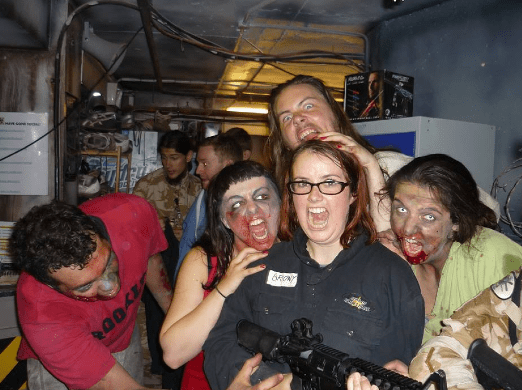
Of the unsuitable wedding ideas considered, the zombie theme was undoubtedly my favourite and I put a lot of thought into the details to make it convincing.

The zombie wedding plans

Zombie weddingThere would be utilitarian themed wedding invites scraped together from the kind of bits of cardboard you’d find breezing around an apocalyptic London where no-one has time to go to Paperchase anymore.

These would include the necessary logistical information but also references to the need to band together to increase our chances of survival.

I envisaged the wedding itself as a fairly non-eventful affair except that at the part when the Priest invites anyone to declare any reason why we couldn’t get married some ‘zombies’ would bang loudly on the church door and groan.

The service would conclude and guests would be carefully chaperoned to the wedding reception venue by Shaun of the Dead inspired groomsmen armed with cricket bats and old records.

Serving staff would already be undead (I was thinking actors, students or some other bunch of reprobates) with chains to limit their movement. You can take a drink but would have to try not to let them bite you.

For our wedding breakfast we could have provided packets of Wotsits, tins of cold baked beans, mouldy cheese, beer cans and other larder items scavenged from deserted houses. Decorations could have been paperchains fashioned out of blood spattered old newspapers and stubs of candles in old wine bottles would have provided suitable Armageddon-esque romantic lighting. All in keeping with the concept, and cost-effective too.

Rather than the usual party games for tables of strangers, guests would be provided with scrappy pencils and recycled paper and asked to plan their escape from the reception to a nearby safehouse and there’d be a competition to come up with the most inventive way of killing zombies with only the contents of the room available to them.

Photos would have been in two stages. Initially guests in their nice outfits and looking their best. Then we’d have had a face painter whose job would be to gradually transform guests into zombies. Later, another round of photos and if guests happened to be drunk and covered in Wotsit dust by this time then so much the better.

By the end of the night I imagined everyone having been bitten and transformed into a zombie so that party time could be everyone dancing to Thriller on repeat, drinking brain cocktails, eating cake shaped like a decomposing body and occasionally shouting out ‘brains’ to make the zombie bride and groom try to eat each other.

The reaction

My dad, reasonably confident I was joking, entered into the spirit of my zombie wedding idea and at an engagement party took great pleasure in sharing plans with aunts and uncles. He was pretty convincing and the measured looks on their faces as they tried to weigh horror at such an idea against likelihood it was a joke was highly entertaining. Except for Grandma who accepted the concept without question, laughed that she wouldn’t have to dress up and promptly settled herself into an armchair with a glass of sherry.

I got so carried away with the idea of my joke wedding that I managed to convince myself that any alternative would be a disappointment. When it became apparent it was less of a joke than it had initially seemed I received strong feedback from people, fiancé included, that an undead wedding really wasn’t a great idea.

I realized I could maturely respond to wedding excitement had two options:

1) I could find a new fiancé, friends and family that might be onboard with the wedding/judgement day of my imagination.

2) If I wasn’t allowed that wedding I’d have to engineer a situation whereby any wedding seemed wholly unfeasible.

I chose option number two, moved to Geneva and made the poor fella quit his job and follow me to one of the most expensive cities in Europe where we couldn’t afford a wedding (zombie or otherwise) even if we wanted to.**

How d’you like them (rotten) apples, eh?


*This is a good test to see if the fiancé actually reads my blog or just pretends to and if he does read it how much trouble I will get in for writing this!
**Please note I may or may not have moved to Geneva for reasons other than avoiding/stalling my own wedding

Judge, Jury and Executioner

Standard

“I think fish is nice, but then I think that rain is wet, so who am I to judge?” – Douglas Adams, The Hitchhikers Guide to the Galaxy

I am a huge fan of the Humans of New York (HONY) website (you can also follow the page on facebook for feel-good hits throughout the day). Brandon, the man behind HONY, takes a photo of a random individual and then he asks a few probing questions to get a snapshot of that person’s story. The images instantly evoke one idea, but the brief snippet of dialogue calls us to question our preconceptions and think a little bit more about the human behind the image.

From the snappily dressed businessman, to the homeless man to a middle-aged couple everyone has their story to tell and it isn’t necessarily reflected by their outward appearances. HONY is a brilliant blog that reaches an audience of millions and is teaching all of us to think before we judge.

I believe it comes naturally to judge people, we can’t help it. But we can try to overcome this tendency by questioning why we do this.

We are human and we respond with a variety of emotions, that we don’t consciously control, towards those around us. These feelings have been shaped by our experiences and the societal norms we unconsciously absorb every day.

So if we feel uncomfortable if someone asks for our number that’s probably because we have had a bad experience in the past. We then project that recognition of a negative encounter onto a new situation. If we feel awkward when a homeless man asks us for money it’s because we feel having a home is important and their approaching us makes us question why some people don’t have this.

If someone is constantly late or fails to show up to a meeting we may decide they are unreliable. We are interpreting their actions by what is important to us. In this case keeping to an agreed appointment is important to us and therefore we negatively judge anyone who does not attribute the same importance to this. Late again - BP image

But that same person, that regularly flakes out on you, may also be someone who would drop everything, including bailing on existing commitments, to be there for you if you really needed them. And this may be a trait we also rate highly even though it contradicts the first.

We may think a person is wonderful because we respect X, Y and Z characteristics and therefore admire those in others or we may think someone is terrible because of traits A, B and C that we don’t value. Someone else might think aspects A, B and C are much more admirable than X, Y and Z.

There is no right answer as to what’s better, it’s simply personal preference. Judgement is, therefore, entirely subjective.

It’s easy to judge others. It’s easy to think so-and-so at work is stuck up and looks down on us, or that someone is unnecessarily rude to us, or that another person who makes us tea on a daily person is the best person to ever walk the planet.

But judging others says more about us than them. If we think someone is looking down on us then that reveals our own insecurities by suggesting we think they have something to look down on. If someone is rude to us we should think about why it bothers us or what has happened to them to cause them to be so rude rather than marking them down as a ‘bad’ person. If we think it’s great that someone makes us tea it’s because we really like tea (yes, I am living up to the English stereotype) and value their thoughtfulness in thinking of our needs.

A friend, also comparatively new to Geneva, told me about an incident when she was walking home alone one evening, along an almost deserted street. She was approached by a slightly drunken man who asked for her phone number. She told him she had a boyfriend but he persisted anyway saying he just wanted to talk. When she questioned him on this he admitted with a smile that he didn’t just want to talk. When she still refused to give him her number he asked her if he could just have a hug instead.

She told me that her first thoughts were ‘absolutely not, who was this person, what if he tried to assault her, or steal from her’ but then she opened herself up to the idea that maybe he was just another human being, like her, who was just looking to make a connection. And so she agreed.

She said the hug was so warm and full of kindness that he hugged her as though she were an old friend he had known forever. And then he left. Without having taken any of her belongings, without attacking her and without asking again for her phone number. Months later and she still remembers how wonderful that hug felt.

If we are aware of our tendency to judge then maybe we can try to check that natural feeling and open ourselves up to the idea that every single one of us is a unique and fascinating person, subject to their own experiences and with their own stories to tell that has shaped who they are. This planet is a vibrant tapestry of interesting people from every walk of life and if we could be less judgemental then maybe we could give these people an opportunity to enrich our lives.

(Please note I take no responsibility for anyone who opens up their lives to a complete bunch of nutters unless that person is also a nutter and now has lots of nutty friends in which case I will take full credit.)

The unexpected surprise of an early morning

Standard

“Morning is wonderful. It’s only drawback is that is comes at such an inconvenient time of day.” – Glen Cook, Sweet Silver Blues

Generally I’m not a morning person and I usually like to start my weekends in a lazy fashion, with a bit of a lie-in and then lounging around over a leisurely breakfast watching some sort of trashy tv (and since Netflix is now available in Switzerland a whole new world of trashy options has been opened up for me – hellooo Gossip Girl!).

But this Sunday I had to come into work for an important meeting, which takes place every six months and always involves at least one day’s work over the weekend. This involves not only getting up earlier than I would usually do on a weekend but actually getting up earlier than I would usually do if I were going to work, which for a non-morning person comes as a bit of a shock.

So last Sunday morning my alarm went off far too early and I bumbled around the flat with bleary-eyes, trying to find my toothbrush (charging in the kitchen) and keys (eventually located in another work bag) so that I could actually get out of the flat, without having to climb out the window, with reasonably fresh breath.

Finally, I was ready to leave, but still in plenty of time despite the minor setbacks, as I got up extra extra early (for me). It’s an important meeting and I didn’t really want to leave anything to chance so I factored in time for the toothbrush tracking, key-locating and about 10 other potential mini-mishaps.

Venturing out of the flat I released my bike from it’s cave* to ride to work in the early morning light.

Riding my bike to work is one of my favourite moments of every working day. There is something incredibly liberating about riding a bike, especially when it comes with the added bonus of the smug awareness that it’ll get me to work faster than the bus.

Actually let me just amend that. There is something incredibly liberating about riding a bike in a bike-friendly city like Geneva, which has on the whole been a positive experience (aside from one minor, albeit expensive, brush in with the law for running a red light see ‘Daring to dare but don’t dare to run a red light’). Cycling in Phnom Penh, Cambodia, was liberating but more in the sense of an almost-liberating-myself-from-the-land-of-the-living, dicing-with-death, experience navigating a treacherous path amongst trucks, jeeps and tuk-tuks loaded up with people and produce, who may or may not have been driving on their designated side of the road, if on the road at all. 

But riding to work on a Sunday morning in Geneva, with barely a whisper of traffic, was an entirely pleasurable experience. Whizzing through the almost deserted streets felt kind of magical. There is something rather wonderful in knowing that you are awake and active when most people aren’t. And being up and about, on my way to an important meeting, hours earlier than I would probably even have woken up under more typical Sunday circumstances, felt like something to be proud of in itself. It was an unexpectedly enchanting way to start the day.

When I was studying for my law diploma in London, exams would happen once every three months on a Saturday morning and every time I would experience this same strange sensation. The heart pumping from the adrenaline needed to accomplish an upcoming event (then the exams, Sunday pulling off the meeting without a hitch), added to the buzz of being almost alone in a normally busy town (and not just for the opportunity it afforded to pretend a zombie apocalypse is underway) topped off with the somewhat conceited self-satisfaction of knowing that by the time I’d normally be ready to face the world, I’ll already have achieved something.

I’d like to say that I’ll repeat the experience voluntarily by setting my alarm for 6am on Saturday to go for an early morning run and revive the mystical circumstances. But…But…But I don’t think you can force these things… and I wouldn’t want to disturb the cats…and I would probably do myself some sort of an injury setting off at that time. And any number of other excuses to explain the fact I just don’t want to.

Magical morning experience over mooching about until noon? I’ll take the mooching thanks. I already admitted I wasn’t a morning person.


* I really love that in Geneva cellars/garage/general storage-holes are referred to as caves.

Unstuck in time

Standard
This week I have been trying to plan a number of international calls for my boss. I have a useful device on my computer where I can easily compare the times of our office with those he regularly connects with around the world. So usually this is pretty straight forward, except that I have been trying to coordinate calls that will happen after the clocks have changed in Geneva. In some countries clocks don’t change at all and in others they don’t change when ours do. And for some reason trying to figure this out makes my brain bleed.
I can check a hundred times that in a particular week Geneva will be an additional hour ahead of New York but when I look at the time scroller I can’t compute the adding on of that extra hour and have to start again. It’s like a clock whose hands are sweeping past the minutes of its face and I can’t get it to slow down enough for me to figure it out.
P1000461The concept of time is a strange thing and I’m not 100% sure that I believe in it as I am supposed to. A month or two back we read Kurt Vonnegut’s ‘Slaughterhouse-Five’ for book club. The book is told in a non linear fashion and centres around the character of Billy Pilgrim who becomes ‘unstuck in time’.
I read the book and listened to the club debate whether it should be classified as science fiction, whether Billy should be considered to be suffering from post-traumatic stress disorder or whether the unsticking in time is simply an old man reminiscing. Being the somewhat simple person that I am I read it and just accepted the time travel as a perfectly normal aspect of the narrative.
To be honest it kind of made sense. I think I know that time moves in a regimented, chronological, one-minute-follows-another-minute sort of way, but that’s not how we experience it. So I wonder if the concept of time that I think I know is just one version of the reality of this?
I’ve been experiencing déjà vu quite a lot recently, that sense of half-remembered names and faces that I’ve already encountered some time ago. I looked online and found a lot of simple(ish) scientific explanations for déjà vu. But what if the explanation is even simpler, a moment or experience feels familiar because you actually have seen or experienced it before at another time?
Perhaps time is much more like a wheel within a wheel than the straight line we think, and every so often whilst spinning around one wheel we might get teeny glimpses of something that’s on another wheel we aren’t supposed to be circling yet? Like the fleeting moment of identifying a face in the crowd when on a ride at a fairground before the image is snatched away.
When they first turned on the large hadron collider at CERN, which I visited last weekend, there were fears that it would create a black hole and destroy life as we know it. The scientists involved said that was ridiculous and wouldn’t happen but when asked what would be the outcome of their work they didn’t, and still really don’t, know what the effects might be. Nerds (myself included) across the world are mostly keeping our fingers crossed for the coolest possible scientific outcome, that is to say time travel.
LHCbI like time travel stories and the fiancé and I have just decided to start watching all the rebooted Doctor Who (from 2005) from episode one, series one. I love the show but it always leaves me with a lot of questions.
Like how is anything ever a surprise for the Doctor? For example when he meets a potential new companion, how does he not instantly recognize them from future memories? When he’s in a sticky situation why can he never remember how to get out of it? And also, why are his companions always pretty young women? My constant questions become words that jangle in my head and are probably evidence of my tendency to over-think things rather than just go with the flow but the whole concept of time travel is just a circle in a spiral that keeps on spinning!
The idea of being able to visit different ages and different periods in history is definitely appealing. I’m pretty sure I’d make an excellent Tudor and would obviously love to see if hover cars ever do become the reality futuristic films promise.
OLYMPUS DIGITAL CAMERABut if you had the ability to time travel would you be able to avoid the temptation to visit your own history? If you could change the things you are not proud of or glimpse into the future to see what happens, would you? And if you could time travel and could make the odd adjustment here and there would this change who you are? If you knew your future would you experience your life differently?
And if time isn’t altered so easily and isn’t so much a line as a circle would we, like Billy Pilgrim, live our lives on a constant loop, that never really ends or begins but rather lurches from one key moment to another? Would life become a trap, a nightmarish existence of endlessly reliving every moment?
Would I at least be able to figure out what time zones Geneva and connecting cities are in, relying on future successes, or would I have to experience the pain of figuring this out for an eternity?

10 reasons not to be afraid of feminism

Standard

“I call myself a feminist. Isn’t that what you call someone who fights for women’s rights?” – The Dalai Lama

“We cannot all succeed when half of us are held back” – Malala Yousafzai

Feminism seems to be something that sparks a lot of heated debate although I’m not really sure why as essentially it’s just about equality between men and women and I think that’s hard to argue against. But to help clarify things I thought I’d present ten reasons why people don’t need to be afraid of feminism.

1. Not all words ending in -ism are bad

Yes ‘Nazism’, ‘Stalinism’ and ‘terrorism’ are definitely some bad -isms but this doesn’t make all words ending in -ism are inherently evil. If you do google-search for words ending in ‘ism’ you will probably find more rubbish examples than good ones, but without ‘ism’ we couldn’t have ‘heroism’ or ‘idealism’. Heroism (art by B. Potts)

2. Feminism remains necessary as people are still treated differently because of their gender

Even just looking at things from a Western perspective although women may have equality in theory it doesn’t always amount to equality in practice. I could go on about female representation in public spheres like the government, legislature and judiciary but that would probably add another thousand words to this post so I’ll just invite you to check out Laura Bates’s everyday sexism project to get an idea of why feminism is still required in the so-called developed world. Every woman I’ve spoken to about this has at least one story of when they have been made to feel uncomfortable by a man in a way that wouldn’t have happened had they not been a woman.

Some men, and definitely not all, because most men I know wouldn’t dream of behaving in this way, but some men think it’s alright to objectify women, to grab their bottoms, to shout obscenities at them from moving vehicles, to comment on their tits and genuinely treat them as objects for their amusement. I suspect that some of the men that do this would actually be quite shocked by how much this sort of thing can really get under a person’s skin and make us feel uncomfortable. So a comment on our booty might be meant kindly but please forgive us if we react badly, from our experiences of this sort of thing happening quite frequently we are likely to be more sensitive about these things and, perhaps not wholly surprisingly, we will take personal comments well… personally.

This kind of unwanted attention is more likely to happen to women but yes this does also happen to men. Behaviour that intimidates, harasses or upsets anyone in this way, whatever gender they are, isn’t acceptable.

3. Feminism isn’t about hating-men

Being a feminist doesn’t mean you hate men. It’s not like racism (another bad -ism) where you want to assert the superiority of one kind of person over another, so being a feminist doesn’t mean you believe in female superiority and eagerly await the subjugation of all men to the complete domination of women.

Alright some people who call themselves feminists might want that but they have sort of missed the point and shouldn’t be considered representative of all feminists. Feminism is actually about wanting gender equality for both men and women.
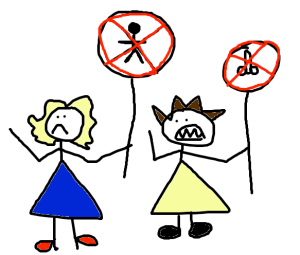
Men hating (art by B Potts)

4. Feminism doesn’t mean all men are rapists

Feminism often focuses on rape because this is a problem, it happens far too frequently, often goes unreported or isn’t always taken as seriously as it should be. Feminists highlight the dangers of rape because it’s a terrible thing no-one should have to experience, it doesn’t mean feminists think every man is a rapist.

A bit of a tangent about the nail varnish thing…

There was a bit of fuss recently after some chaps invented a nail polish that changed colour when dipped in a drink that had been spiked. At first everyone thought this was great because helping people not be raped is surely a good thing. Then there was a bit of a backlash from some of the angry feminists types who tend to put people off the whole thing, who were getting up in the grill of the inventors faces and saying things like ‘how dare you assume rape is just women’ and ‘why should the onus be on women not to get raped, why not figure out how to stop people thinking rape is okay’.

I would like to respond to these two points. Firstly why assume men wouldn’t wear nail varnish and even if they don’t want to that doesn’t stop this being useful. If you discovered a cure for cancer that could only help ginger-haired people but couldn’t cure cancer for everyone it’d be pretty dastardly to say to ginger-haired people sorry you can’t have this until we’ve figured out a fix for everyone.

To the second argument it’s not like the inventors were saying ‘hey it’s okay to rape anyone who doesn’t use our nail varnish’ it’s simply that they thought they could do something to address a serious problem which sadly exists in the actual world we live in as opposed to the utopia we’d all like where rape doesn’t happen. Saying the inventors of rape-deterrent nail varnish are saying it’s up to women not to get raped is like saying I should be able to leave my bike unlocked in Geneva outside without anyone taking it. Yes I should be able to leave my bike unlocked because stealing my bike would be wrong. However as some people would steal my bike whether or not I think it’s wrong I’m grateful someone invented bike locks.

5. Admitting a need for feminism doesn’t mean pretending there are no other problems in the world

Sexism happens. It’s not the only awful thing that happens in the world. However the existence of other terrible things doesn’t mean sexism doesn’t exist and that it isn’t a problem that shouldn’t be addressed. It’s not a competition, it’s just about trying to improve the world in whatever way we can.

Feminism is about addressing discrepancies between genders and achieving real gender equality will help some people. It won’t solve poverty, famine and disease. But we aren’t ranking these things. Otherwise we would all have to agree on the one most single awful thing in the world and say we can’t even consider other issues until this was resolved. It would be like saying the police shouldn’t investigate kidnap cases until all murder cases have been solved.

Sadly there are many bad things in the world, happily there are lots of good people that want to work in different ways to try and make things better.

6. Feminism doesn’t mean women can never wash, shave, put on nice clothes or make-up

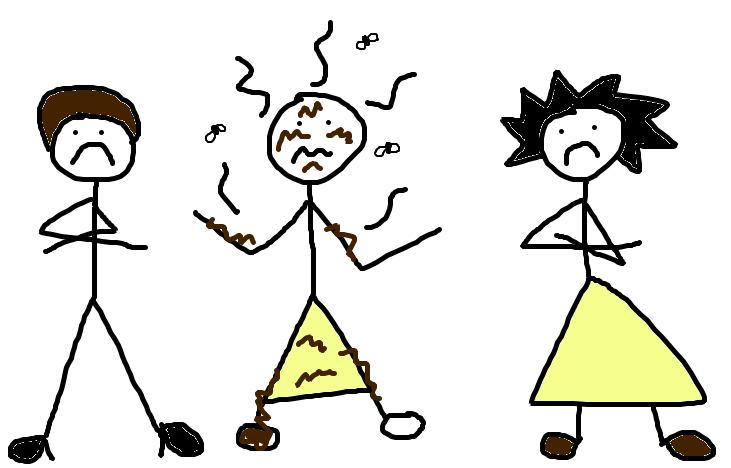
Feminism means women are free to make a choice about whether they wash, choose to shave, what clothes they wear or whether they want to apply make-up, and that no-one should feel they have to do these things just for the benefit of someone else. Although, actually, all genders should try and wash occasionally, for the benefit of your fellow humans who otherwise have to smell you.

Just last night I was painting my nails whilst reading a book on women’s human rights. This doesn’t make me less of a woman or a rubbish feminist because first of all, it’s not an either/or situation and second of all, I believe it’s up to me to be a ‘woman’ in whatever way I choose. Sometimes that involves painting my nails, sometimes it involves bumming around in jogging bottoms all day. It’s my call.
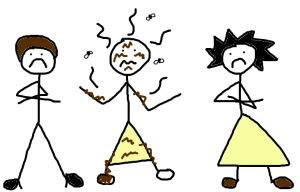
Not washing (art by B Potts)

7. Feminism isn’t about denying bad things happen to men

Feminism is about levelling the current power imbalance between genders. It tends to focus on women because on the whole the power imbalance is against women. However it doesn’t mean denying that issues which more often affect women than men, also affect men and can be perpetrated by women.

For example there are serious issues about disbelief of male victims of rape or domestic abuse by people who don’t believe this could happen. This isn’t something to laugh off, it’s a serious issue and changing attitudes towards these victims is all part of feminism.

Someone suggested that feminism should be renamed equalism so as not to irritate people so much. I see their point in that feminism is really an issue of equality it’s just that if we don’t give it a gendered terminology then it wouldn’t necessarily be clear as to what feminism is about.

I’m a humanist in that I believe everyone should be treated equally regardless of gender, sexual orientation, race, ethnicity, religion or any other category you want to throw in there. I’m also a feminist because feminism is addressing one of these areas of discrimination and if I say feminist then we all, more or less, know what I’m talking about.

8. Feminism doesn’t turn all women into victims

Feminism isn’t about the victimisation of women, it’s not about saying women can’t do anything for themselves and that they will always be oppressed by men. It’s about acknowledging there is a problem, raising awareness of the problem in the hope that it might affect change and ultimately working together towards a world where we can say feminism isn’t necessary any more. Feminism can actually be quite empowering by helping people of all genders to realise they shouldn’t have to put up with gender biased behaviour that demoralises and demeans them.

9. You don’t have to be a woman to be a feminist

As Emma Watson put it in her recent speech on feminism for the UN “Men – I would like to take this opportunity to extend your formal invitation. Gender equality is your issue too.” There are already a lot of pretty cool men who would identify themselves as feminists, including: Patrick Stewart, Joseph Gordon-Levitt, Ryan Gosling, Prince Harry and the Dalai Lama. 

As a lot of problems of the sort reported on everyday sexism stem from the way men treat women then actually we need more men to step up and make it clear that they think treating women as anything other than human beings is not okay. The more men there are acknowledging the need for gender equality the less feminism can be accused of being a vehicle for angry women to rant about pointless issues (which isn’t really what it’s about at all).

Equalism (art by B. Potts)

10. Feminists can take a joke

Some people think feminists can’t take a joke but that’s simply not true, provided your joke is funny. If your joke is highly sexualised about me and makes me and others in the vicinity uncomfortable, then it’s not really a joke. Jokes about rape are also never going to be funny, there’s a reason why people groan when such jokes are told and that’s because they are awful. Those telling them are going more for shock factor than comedic value and if that’s the best they’ve got in their comedic arsenal then maybe leave the joke telling to actually funny people or look up some new material online.

And one for luck…

11. You can still open a door for a woman without being anti-feminist

There’s no reason for common courtesy to go out of the window just because women want equality with men. No feminist is going to get mad because a man opens a door for her, just don’t get upset if a woman also wants to open a door for a man. You can still be nice to someone without trampling all over them and there’s no need to make this a gender thing. Surely it’s nice if you hold the door open for whoever is behind you or struggling with an armful of books or whatever, regardless of gender.

Opening door (art by B Potts)